Direct Takeaway / Executive Summary
What is a rotating proxy? A rotating proxy is a network gateway that automatically changes your exit IP address—either with every HTTP request or at fixed time intervals (sticky sessions)—from a vast pool of residential, ISP, or datacenter IPs. By assigning a new IP and new digital identity for your requests, ProxyVoxy dynamic rotating proxies eliminate rate-limiting blocks (HTTP 429), prevent IP bans, protect user privacy, and allow automated web scrapers to scale data extraction effortlessly.
If you have ever tried building a web scraper in Python, monitoring competitive product prices, auditing global ad placements, or automating social media accounts, you have likely encountered a sudden wall: HTTP 429 Too Many Requests, CAPTCHA challenges, or permanent IP bans.
Modern websites employ sophisticated security platforms like Cloudflare, PerimeterX, Datadome, and Akamai. These systems monitor traffic velocity. When an IP address sends 100 requests in a minute—far faster than any human can click—the server immediately flags and blocks that IP address.
To overcome this fundamental challenge, data engineers and automation teams rely on Rotating Proxies. In this comprehensive beginner's and developer's guide, we will break down proxy rotation basics, explain how rotating proxy pools work under the hood, compare rotation strategies, and demonstrate how to implement automated proxy rotation gateway in your code.
How Does a Rotating Proxy Work? Deconstructing the Gateway Architecture
Unlike a standard static proxy (where your traffic is routed through a single fixed IP address), a rotating proxy network operates as an intelligent load balancer backed by millions of IP nodes.
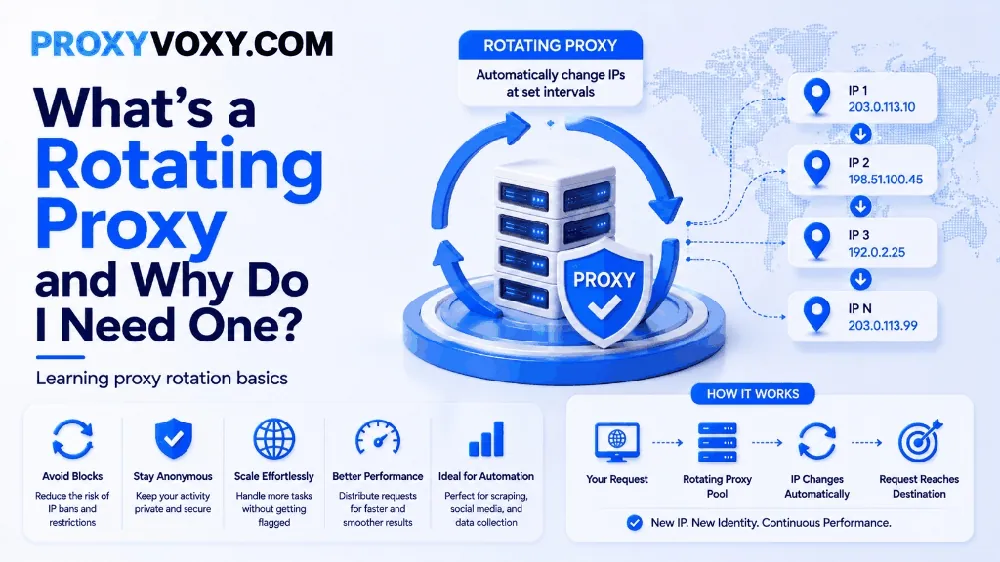
The 4-Step Proxy Rotation Request Lifecycle
- Client Request Initiation: Your web scraper or browser script sends an HTTP request to a single backconnect gateway endpoint (e.g.,
gate.proxyvoxy.com:8000). - Intelligent Gateway Interception: The ProxyVoxy load balancer intercepts your request, authenticates your account credentials, and evaluates your location/session parameters.
- Automatic IP Swapping: The gateway selects a fresh, unblocked IP node (IP 1:
203.0.113.10) from the active pool of millions of online residential devices. - Destination Delivery & Response: The target website receives the request originating from IP 1, treats it as a brand-new human visitor, and sends back the requested HTML payload. For your next request, the gateway seamlessly attaches IP 2 (
198.51.100.45), then IP 3 (192.0.2.25), and so on.
| Feature | Static Dedicated Proxy | Rotating Proxy Pool |
|---|---|---|
| IP Address Behavior | Fixed single IP for the duration of subscription | Changes per request or at set time intervals |
| IP Pool Size | 1 to 10 static IPs | Millions of dynamic residential/ISP nodes |
| Ban Vulnerability | High (If blocked, the single IP is unusable) | Near Zero (Instantly swaps to a new clean IP) |
| Concurrency & Speed | Limited by rate limits of 1 IP | Unlimited parallel worker threads |
| Best Use Cases | Social media management, logged-in sessions | Web scraping, price tracking, SERP harvesting |
Why Do I Need a Rotating Proxy? 5 Core Benefits
1. Avoid Blocks and Bypass Rate Limits
Websites track request volume per IP address. When an IP exceeds a set threshold (e.g., 20 requests per minute), the server returns HTTP 429 or blocks connection sockets. Rotating proxies spread 10,000 requests across 10,000 distinct IP addresses. To target servers, each request appears to originate from a completely different human visitor located somewhere else in the world.
2. Stay Anonymous & Protect Privacy
Every device connected to the internet broadcasts a public IP address linked to its owner's physical location and Internet Service Provider. Rotating proxies act as an impenetrable protective shield, preventing target servers, advertisers, and trackers from mapping your real server identity or local IP address.
3. Scale Data Operations Effortlessly
Scraping enterprise e-commerce portals containing millions of URLs requires high concurrency. With static IPs, running 100 parallel worker threads instantly triggers IP bans. With a rotating proxy network like ProxyVoxy, you can launch hundreds of simultaneous scraper threads without rate-limiting bottlenecks.
4. Superior Network Performance & Load Balancing
If a single proxy node becomes sluggish or experiences packet loss, a static setup freezes your script execution queue. Rotating proxy backconnect gateways dynamically route your traffic around congested or dead nodes, ensuring continuous, high-speed connection throughput.
5. Ideal for Automation & Scraping Frameworks
Modern automation tools—such as Puppeteer, Playwright, Selenium, Scrapy, and BeautifulSoup—require reliable proxy delivery pipelines. Rotating proxies plug directly into these frameworks via standard HTTP/HTTPS/SOCKS5 parameters without requiring complex manual proxy management logic in your source code.
Key Pillars of ProxyVoxy Rotation Technology
- Automated IP Swapping: Rotate exit IPs per HTTP request or set custom sticky durations (5 min, 10 min, 30 min).
- Massive Ethically Sourced Pool: Gain instant access to 90M+ residential IP nodes spanning 195+ countries and thousands of cities.
- High Trust Residential Reputation: Route traffic through real home ISP connections (Comcast, AT&T, Vodafone) to evade anti-bot filters.
- 99.9% Network Uptime: Intelligent failover routing ensures zero job queue downtime for enterprise scrapers.
Types of Proxy Rotation: Per-Request vs. Sticky Sessions
Not all rotation requirements are identical. Depending on your automation workload, you can configure your rotating proxy gateway in two distinct modes:
1. Per-Request Rotation (High-Volume Scraping)
In per-request rotation, the proxy gateway assigns a brand-new IP address for every individual HTTP connection. If your Python script sends 500 GET requests to scrape search engine results, all 500 requests will be executed through 500 distinct residential IP nodes.
- Best for: Price scraping, public data harvesting, SERP tracking, and asynchronous web crawling.
2. Sticky Session Rotation (Stateful Automation)
In sticky session rotation, the gateway assigns a single IP address and maintains that exact IP for a designated timeframe (e.g., 5, 10, or 30 minutes) or until a specific session ID changes.
- Best for: Tasks requiring logged-in user states, shopping cart checkouts, multi-step web forms, and social media interactions where changing IPs mid-session triggers security logouts.
How to Implement a Rotating Proxy in Code
Integrating a rotating proxy with ProxyVoxy requires no complicated local software installations. You simply point your HTTP client or headless browser to ProxyVoxy's backconnect gateway.
Python Web Scraping Example (using requests)
import requests

# ProxyVoxy Backconnect Rotating Proxy Gateway
proxy_gateway = "http://your_username:your_password@gate.proxyvoxy.com:8000"
proxies = {
    "http": proxy_gateway,
    "https": proxy_gateway
}

# Demonstrate IP rotation across 5 sequential requests
for i in range(5):
    try:
        response = requests.get("https://httpbin.org/ip", proxies=proxies, timeout=10)
        origin_ip = response.json().get("origin")
        print(f"Request #{i+1} Executed via IP: {origin_ip}")
    except Exception as e:
        print(f"Request #{i+1} Failed: {e}")
Node.js Automation Example (using playwright)
const { chromium } = require('playwright');

(async () => {
  // Launch Chrome connected to ProxyVoxy's rotating proxy pool
  const browser = await chromium.launch({
    headless: true,
    proxy: {
      server: 'http://gate.proxyvoxy.com:8000',
      username: 'your_username',
      password: 'your_password'
    }
  });

  const context = await browser.newContext();
  const page = await context.newPage();

  await page.goto('https://httpbin.org/ip');
  const ipContent = await page.textContent('body');
  console.log('Visible Proxy IP:', ipContent);

  await browser.close();
})();
Frequently Asked Questions (FAQs)
What is a rotating proxy and how does it work?
A rotating proxy is an intermediary server gateway connected to a vast pool of IP addresses. It automatically changes your external IP address at specified intervals or with every new HTTP request, routing your traffic through different nodes so target servers never see repeated requests from a single source.
Why do I need a rotating proxy for web scraping and data collection?
Target websites enforce strict rate limits (e.g., HTTP 429 errors or CAPTCHAs) when receiving hundreds of requests from a single IP address. A rotating proxy distributes your requests across thousands of unique IP addresses, allowing you to harvest high-volume data without triggering anti-bot bans.
What is the difference between per-request rotation and sticky session rotation?
Per-request rotation switches your IP address for every single HTTP request sent to a target website. Sticky session rotation keeps the same IP address for a specified duration (such as 5, 10, or 30 minutes) before rotating, which is essential for multi-step tasks like maintaining user logins or checkout flows.
Can a rotating proxy guarantee 100% protection against IP bans?
While no tool offers absolute immunity, using high-quality rotating residential proxies dramatically reduces ban rates to near zero. When combined with proper browser headers, randomized delays (jitter), and TLS fingerprint matching, rotating proxies ensure smooth and continuous data pipelines.
Are rotating residential proxies better than rotating datacenter proxies?
Yes. Rotating residential proxies route traffic through genuine consumer ISP connections (like Comcast or AT&T), carrying a much higher trust score than datacenter IPs. While datacenter proxies offer higher raw speed, residential pools are far more effective at bypassing sophisticated anti-bot systems like Cloudflare and Akamai.
How do I configure proxy rotation in Python scripts?
You configure proxy rotation by connecting to a backconnect gateway URL (such as http://username:password@gate.proxyvoxy.com:8000). The gateway automatically swaps the exit IP node for each incoming request without requiring you to manually manage IP lists in code.
Conclusion: Harness the Power of ProxyVoxy Rotation Networks
Understanding proxy rotation basics is the first step toward building resilient, unblockable web automation infrastructure. By automatically switching IP addresses per request or per session, Rotating Proxies eliminate IP bans, bypass rate limits, and preserve complete digital anonymity.
Ready to supercharge your data collection? ProxyVoxy provides gigabit rotating residential and ISP proxy pools starting at competitive rates with 99.9% uptime. Deploy automated proxy rotation today and experience seamless, continuous data harvesting at scale.